
'China refuses to talk to India on nuclear or ballistic missile issues and conclude any de-targeting agreement as Beijing did with Russia or a non-targeting agreement with the US.'
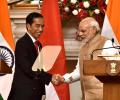
The two countries, among the very few fast growing large economies globally, also decided to boost bilateral trade and investment in areas of oil and gas, renewable energy, IT and pharmaceuticals, during talks between Prime Minister Narendra Modi and Indonesian President Joko Widodo.

More than 2,000 activists of various religious and jihadi outfits in Pakistan on Wednesday protested against the visit of Home Minister Rajnath Singh, accusing him for the unrest in Kashmir.
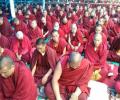
'Given Chinese sensitivity to anything to do with Tibet -- and the fact that in the 1950s it was the Tibet issue which led to the deterioration of India-China relations and the border war in 1962 -- India should be particularly careful in not triggering a Chinese reaction which it may not be able to handle,' says former foreign secretary Shyam Saran.
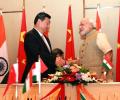
'China's actions at the NSG will certainly taint India-China bilateral relations and enhance suspicion of China's intentions. A fresh clear-eyed and objective evaluation of the India-China relationship is necessary, especially as India tries to correct adversely balanced bilateral economic ties and the two countries engage over the long-term,' says Jayadeva Ranade.
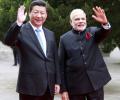
China's Vice Foreign Minister Li Baodong again harped on the need to build consensus over the admission of new members in the 48-member Nuclear Suppliers Group.
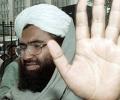
"My impression is that India can expect cooperation from China on the issue of declaring Masood Azhar, leader of JeM, as terrorist who should face trial in India, if India in the UN concentrated more on him than seeking to censure Pakistan as a sponsor of terror," Swamy said.

'If this were to happen, it won't exactly be a game changer because Pakistan is known for treating arrested terrorists as 'political prisoners', who are generally given VIP treatment,' says Rajeev Sharma.

'By beheading an Indian soldier, the Pakistan army has demonstrated its proclivity for barbaric medievalism.' 'The strategies adopted and the punishment inflicted by India must be made progressively more stringent with every new act of terrorism till the cost becomes prohibitive for Pakistan,' says Brigadier Gurmeet Kanwal (retd).

The prime minister also said that country nurtures a mindset that loudly proclaims that terrorism is justified for political gains.
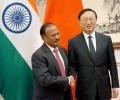
The decision was taken during the annual 19th round of boundary talks in Beijing between National Security Advisor Ajit Doval and his Chinese counterpart Yang Jiechi.

Cancelling Uighur leader Dolkun Isa's visa could have been a mutual face-saving exercise for New Delhi and Beijing.

Voicing concern over recruitment of educated Kashmiri youths into terror outfits, a top army commander has said that eyes cannot be shut to the "tragedy" that "alienation and lack of opportunities" was driving local youngsters towards the gun and the Centre and the state government need to introspect to address these issues.

Countries in the region like Afghanistan, Pakistan and Maldives face serious existential threats from a mix of terrorist groups active in the region and elsewhere

The decision to not attend the forum attended by 28 heads of state and 130 national delegations is a clear break from its usual policy of going along with the crowd.

Swaraj said there is scope to do a lot more and this would be an important element of their deliberations.

India and France on Monday inked an Inter-Governmental Agreement on the sale of 36 French fighter jets, Rafale, but were unable to sign the final deal due to some "financial" aspects, which are expected to be sorted out in "couple of days".

Intelligence agencies draw a list of terror outfits that pose the gravest threat to India. Vicky Nanjappa reports

Vikas Swarup says India unlikely to give Pathankot-like offer to Pak in Uri attack probe.

One thing Beijing must understand is that India is not obsessed with being a threat to China but only wants a rightful place for itself in the world, says Sanjeev Nayyar.
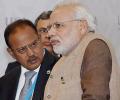
India should adopt a pro-active strategy on Pakistan -- catalysing, facilitating and making room for a change in its anti-India posture.

What India has failed to acknowledge is that sub-conventional war is the name of the game and irregular forces have emerged with greater strategic value over conventional and even nuclear forces, and reliance purely on conventional force and diplomacy is grossly inadequate, says Lt Gen Prakash Katoch (retired).

'The combination of the LeT and the ISI is the most dangerous terrorist challenge in the world because it carries a real and present danger of provoking nuclear war.'

Even as the United States snuggles closer to India with the thinly veiled objective of containing China, the Indian strategy is to avoid alienating either nation.
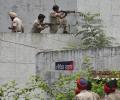
Seven people, including two police officers and a terrorist, were killed as the Punjab Police's elite Special Weapons and Tactics team and the Indian Army were carrying out a massive operation in the Gurdaspur district to flush out terrorists who went on a rampage attacking a bus and a police station complex.

'If, as appears to be the case, India is on way to 'mending fences' with China, and China is equally desirous to 'reset' the relationship, this could be a self-reflexive moment in India's positioning vis-a-vis not just the Dalai Lama, but also the Tibetan issue and China as a whole,' points out China expert Alka Acharya.

Rediff.com takes a look at some cases from the recent past where the courts awarded the capital punishment for horrific crimes that fall under the rarest of rare category.


After weighing all the costs and benefits, the next administration is likely to reduce and restructure assistance to Pakistan but not to end it altogether, says Daniel S Markey.

News of all that's transpired on and off the football field
'If India employed a strategy of a 'thousand cuts', Pakistan will wither away.'

'It is in the interest of both sides that the visit of the US President is seen as being successful. Both sides have invested considerable political capital in it. This rapid exchange of visits and the decisions taken have to be justified, beyond the symbolism, which is no doubt important in itself. This opportunity to impart a fresh momentum to ties should not be missed,' says former foreign secretary Kanwal Sibal.
